
In this interview with Junge Freiheit, I explain the motivations behind my recent visit to Moscow, the nature of the discussions I had in Russia, and the political fallout within the European Parliament.
Here’s a brief summary of the article 👇👇👇
In May this year, MEP Fernand Kartheiser undertook a controversial trip to Moscow – a decision that sparked both criticism and attention across Europe. In a recent interview, the Luxembourgish politician explains the motivations behind his visit, the nature of his talks in Russia, and the political fallout within the European Parliament.
A former career diplomat, Kartheiser has long believed that dialogue between nations is crucial, especially in times of tension. “The political suppression of all contact with Russia is dangerous and leads to a dead end,” he says. His decision to travel to Moscow was both a rational step and a personal response to what he describes as the growing Russophobia in European politics.
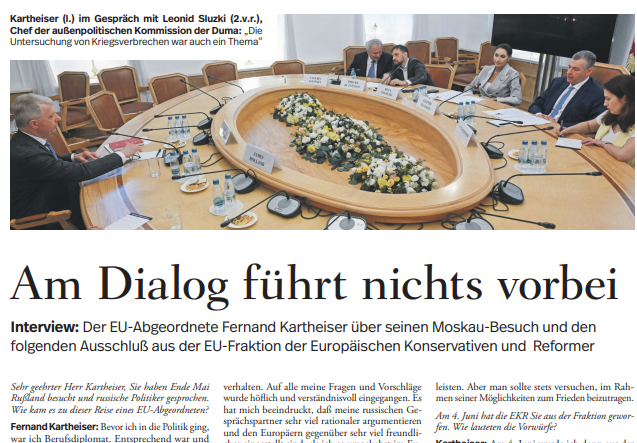
During the visit, Kartheiser met with prominent Russian figures, including Leonid Slutsky, Chairman of the Duma’s Foreign Affairs Committee, and Deputy Foreign Minister Alexander Grushko. Discussions focused on difficult but essential topics such as the protection of civilians, humanitarian aid, ceasefire initiatives, and human rights. “The Russian side was open and constructive. I was struck by how much more rational and respectful they were compared to what I often witness in the European Parliament,” he noted.
The political repercussions followed swiftly. On June 4, Kartheiser was expelled from the European Conservatives and Reformists (ECR) group – a political family he had been part of for 15 years. The trip to Moscow was cited as a major reason, seen by some within the group as having crossed a « red line. » Kartheiser, however, criticized the dominance of strongly anti-Russian voices within the ECR, particularly from the Polish PiS and certain Baltic and Scandinavian parties. He also revealed that many colleagues within the group had quietly supported him or abstained from the vote.
Now serving as a non-attached MEP, Kartheiser is open to future cooperation with other political groups but plans to remain independent for the time being. Public reaction to his initiative, he says, has been largely positive – both in Luxembourg and across Europe. “It seems the public understands the importance of dialogue much better than many political leaders in Brussels,” he observes.
In conclusion, Kartheiser considers the trip a success. “Thanks to the openness of the Russian side, I was able to demonstrate that dialogue is both possible and meaningful. Even small efforts can contribute to peace – and I see it as my duty to make that effort.”