I recently wrote to European Anti-Fraud Office (OLAF) to raise concerns about the protection of EU taxpayers’ money in Ukraine.
Following an earlier exchange with European Court of Auditors, which confirmed it cannot carry out on-the-ground checks due to security constraints, I asked OLAF how it is ensuring effective oversight in a country still facing serious corruption risks.
In its reply, OLAF stresses that safeguarding EU financial interests remains its top priority. It points to long-standing cooperation with Ukrainian authorities, a strong legal framework such as the EU-Ukraine Association Agreement, and ongoing work with anti-corruption bodies including the National Anti-Corruption Bureau of Ukraine.
However, important questions remain:
– How effective is oversight without a sustained on-the-ground presence?
– How are risks of fraud and misuse concretely assessed in wartime conditions?
– And what measurable results have been achieved?
With significant EU funds at stake, transparency and accountability are essential.
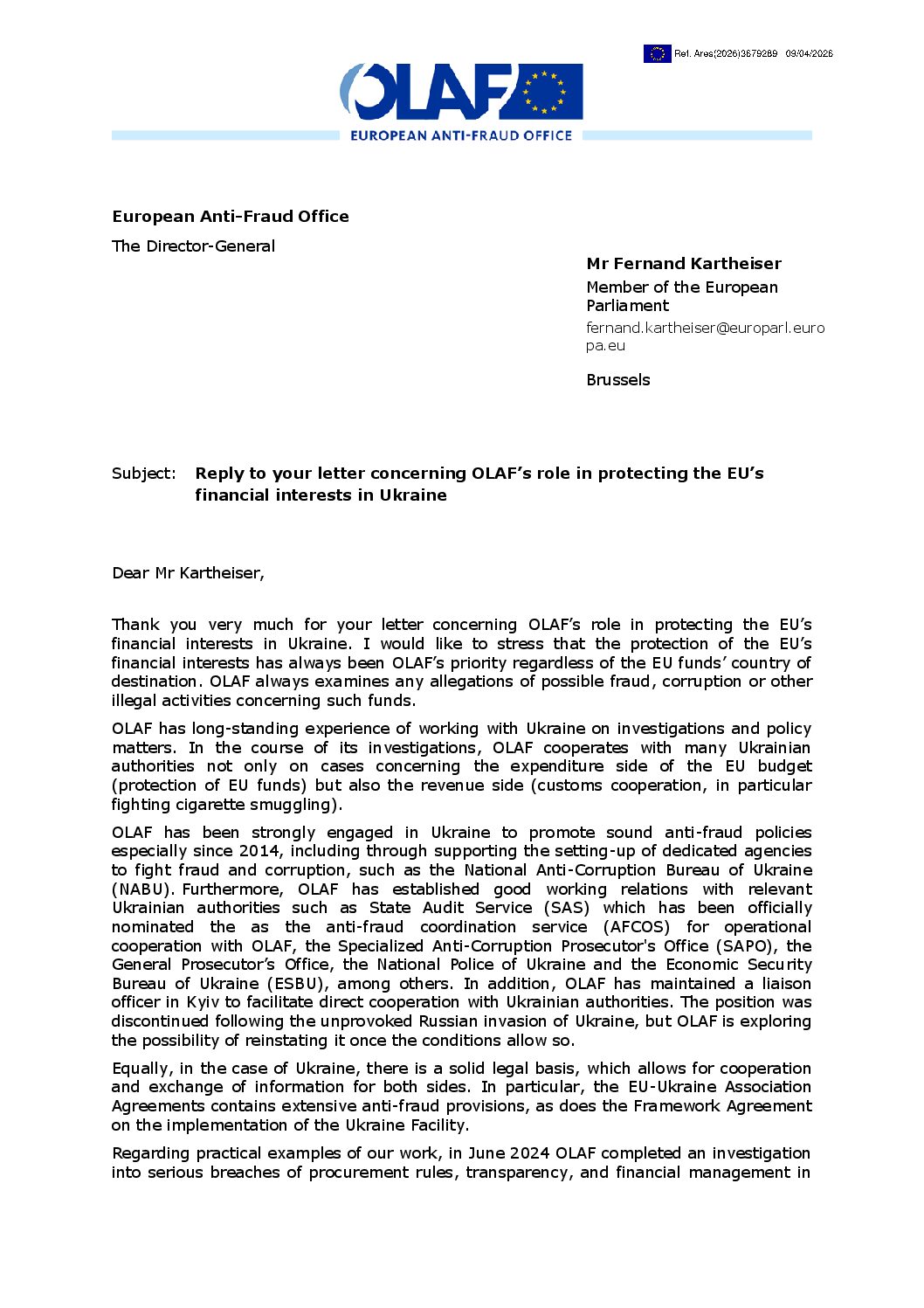
Please read my letter below to OLAF:
Dear Mrs Director-General,
This letter is about the effective protection of European Union funds destined for Ukraine. Recent revelations have highlighted that Ukraine continues to suffer from endemic corruption at the very highest levels of government.
I am writing to you following an exchange of letters with Tony Murphy, President of the European Court of Auditors (ECA), concerning the institutional oversight of European Union financial support to the Ukrainian government.
The ECA stated in its reply of 9 April 2025 that while it continues to audit EU funds destined for Ukraine, security constraints currently prevent it from exercising on-the-spot audit missions. The ECA also recalled that it has no mandate to investigate suspected cases of fraud or corruption, and explicitly indicated that such matters fall within the competence of the European Anti-Fraud Office (OLAF).
With this clarification in mind, I would like to respectfully request information on whether OLAF is currently examining, or intends to examine, any allegations, risks or indications of misuse, fraud or corruption concerning EU financial assistance to Ukraine.
While fully recognising and respecting the investigative confidentiality constraints under which OLAF must operate, I would be grateful for any information-general or non-casespecific- that you may be able to share regarding ongoing risk assessments or systemic vulnerabilities you have identified in this context.
Furthermore, given the limited access to Ukrainian territory highlighted by the ECA, I would appreciate information on how OLAF is adapting its investigative methods to ensure effective control and cooperation with Ukrainian authorities, and the adequate protection of EU taxpayers’ money under these difficult wartime conditions.
Any recommendations you may have for Members of the European Parliament regarding how we can support or facilitate OLAF’s work would also be very welcome. Should OLAF not yet be active in Ukraine, it would seem highly appropriate and prescient for your esteemed institution to increase its engagements with Ukrainian authorities given the reports of corruption and the vast sums being mentioned.
The answer from OLAF:
Dear Mr Kartheiser,
Thank you very much for your letter concerning OLAF’s role in protecting the EU’s financial interests in Ukraine. I would like to stress that the protection of the EU’s financial interests has always been OLAF’s priority regardless of the EU funds’ country of destination. OLAF always examines any allegations of possible fraud, corruption or other illegal activities concerning such funds.
OLAF has long-standing experience of working with Ukraine on investigations and policy matters. In the course of its investigations, OLAF cooperates with many Ukrainian authorities not only on cases concerning the expenditure side of the EU budget (protection of EU funds) but also the revenue side (customs cooperation, in particular fighting cigarette smuggling).
OLAF has been strongly engaged in Ukraine to promote sound anti-fraud policies especially since 2014, including through supporting the setting-up of dedicated agencies to fight fraud and corruption, such as the National Anti-Corruption Bureau of Ukraine (NABU). Furthermore, OLAF has established good working relations with relevant Ukrainian authorities such as State Audit Service (SAS) which has been officially nominated the as the anti-fraud coordination service (AFCOS) for operational cooperation with OLAF, the Specialized Anti-Corruption Prosecutor’s Office (SAPO), the General Prosecutor’s Office, the National Police of Ukraine and the Economic Security Bureau of Ukraine (ESBU), among others. In addition, OLAF has maintained a liaison officer in Kyiv to facilitate direct cooperation with Ukrainian authorities.
The position was discontinued following the unprovoked Russian invasion of Ukraine, but OLAF is exploring the possibility of reinstating it once the conditions allow so.
Equally, in the case of Ukraine, there is a solid legal basis, which allows for cooperation and exchange of information for both sides. In particular, the EU-Ukraine Association Agreements contains extensive anti-fraud provisions, as does the Framework Agreement on the implementation of the Ukraine Facility.
Regarding practical examples of our work, in June 2024 OLAF completed an investigation into serious breaches of procurement rules, transparency, and financial management in European Anti-Fraud Office